
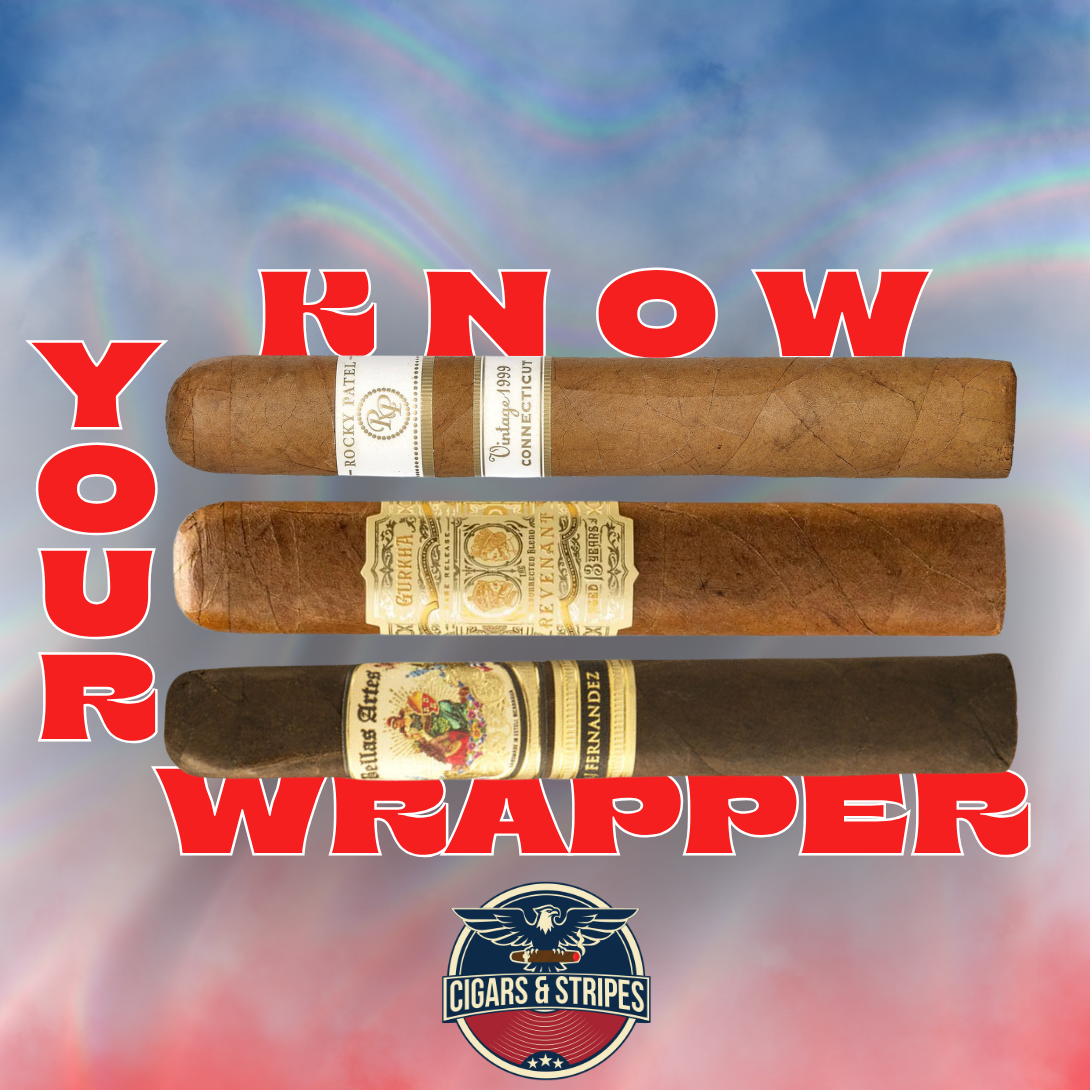
Pick up any cigar and the first thing you notice is the wrapper — that smooth, often beautiful outer leaf that gives the cigar its colour and its finish. Beginners tend to assume it’s just the packaging. It’s anything but. The wrapper is one of the most influential parts of a cigar, and learning to read wrappers is one of the most useful skills you can develop as your palate grows. Here’s what a wrapper actually is, the major varieties you’ll encounter, and how much it really shapes what you taste.
The Three Layers of a Cigar
Think of a premium cigar as having three layers: filler, binder, and wrapper.
The filler is the bunch of tobacco leaves running through the centre of the cigar, and it makes up most of its mass. Wrapped around that is the binder, a tougher leaf whose main job is structural — it holds the bunch together and helps the cigar burn properly. Finally comes the wrapper: the beautiful, thin outermost leaf you actually see and touch, wrapped around the cigar in a spiral and finished at the head with the cap you eventually cut.
What makes the wrapper fascinating is how important that relatively small amount of tobacco can be. Because it’s on the outside, it burns along the entire length of the cigar, and its aroma sits right under your nose and against your lips. So it can have an outsized influence on the cigar’s flavour, aroma, sweetness, spice, and overall character. It’s also the cigar’s “face,” which means wrapper leaves are selected not only for flavour and combustion but for appearance — they need to be supple, relatively blemish-free, and strong enough to survive rolling. That’s why beautiful wrapper tobacco is among the most prized and expensive leaf in the entire cigar. The filler may provide much of the engine, but the wrapper provides an enormous amount of the personality.
A Beginner’s Guide to Wrapper Varieties
Once you start paying attention to wrappers, things get confusing fast. You’ll see names like Connecticut, Habano, Corojo, Cameroon, and San Andrés — but those names don’t always mean the same kind of thing. Sometimes a name tells you the tobacco variety, sometimes where it was grown, sometimes how it was grown or processed. So it’s best to treat wrapper names as clues to what you might experience, not guarantees of what you’ll taste.
Here are the major ones you’ll meet:
? Connecticut Shade — Traditionally grown under shade cloth in Connecticut’s River Valley, and now very commonly in Ecuador. This golden leaf tends toward creamy cedar, hay, toast, nuts, and gentle sweetness.
? Connecticut Broadleaf — Despite the shared name, a completely different animal: thicker, darker, more rugged. Rich earth, cocoa, espresso, molasses, dark fruit, and pepper. Frequently used for Maduro wrappers and prized for natural sweetness.
? Habano — Cuban-seed tobacco grown in places like Nicaragua and Ecuador. Often cedar, earth, leather, pepper, coffee, and spice.
? Corojo — Another Cuban-rooted tobacco, tending peppery and lively, with cedar, leather, earth, and plenty of spice.
? Criollo — Also Cuban heritage, commonly bringing earth, nuts, cedar, leather, sweetness, and spice.
? Cameroon — Grown in Central Africa, known for a distinctive mix of natural sweetness and spice, often with cedar, nuts, floral notes, or even a hint of citrus.
? Sumatra — Originating in Indonesia, tending earthy and aromatic, with cedar, nuts, spice, and sweetness.
? Ecuadorian Connecticut & Ecuadorian Habano — Ecuador’s naturally cloudy skies diffuse sunlight, producing thin, supple wrappers. The Connecticut version is typically creamy and nutty with a little pepper; the Habano goes richer, with leather, earth, cedar, spice, coffee, and sweetness.
? Mexican San Andrés — Grown mainly in the San Andrés Valley of Veracruz, famous for deep dark chocolate, espresso, earth, pepper, and a mineral quality, often with plenty of natural sweetness. A darling of Maduro lovers.
? Brazilian (Mata Fina & Arapiraca) — Mata Fina, from Bahia, offers earth, cocoa, coffee, dark fruit, and sweetness; Arapiraca, from Alagoas, brings a similarly dark, earthy profile with leather, coffee, cocoa, and spice.
? Nicaraguan & Dominican — Nicaraguan tobacco (from regions like Estelí, Jalapa, and Condega) leans robust: earth, pepper, coffee, cocoa, sweetness. Dominican tends more aromatic and refined: cedar, nuts, cream, earth, and gentle spice.
These are tendencies, not rules — seed variety, soil, climate, fermentation, and the rest of the blend all shape what reaches your palate. Notice, too, how the terms overlap: a cigar might be described as having an Ecuadorian Connecticut, a Nicaraguan Corojo, or a Mexican San Andrés Maduro wrapper, where one word tells you the genetics, another the growing region, and another the processing.
Don’t feel like you need to memorize all of this before walking into a humidor. The fun is in gradually connecting the names to your own experiences. Eventually you’ll pick up a cigar, see “San Andrés” on the description, and think, “Ah — I know what I tend to like about that.” At that point wrapper terminology stops feeling like a foreign language and starts becoming a useful roadmap for exploring the enormous range of flavours premium tobacco can offer.
Don’t Over-Credit the Wrapper
Here’s an important reality check: yes, it’s absolutely possible to over-credit the wrapper. It’s the most visible leaf, so it naturally gets most of the attention — but a premium cigar is a blend.
The filler makes up most of the tobacco and provides much of the cigar’s foundation: strength, body, combustion, and a huge amount of its flavour. The binder isn’t just packaging either; depending on the leaf, it can contribute flavour and influence how the cigar burns. The wrapper then adds its own character on top of all that. Because it’s burning right under your nose and touching your lips, its contribution can be surprisingly noticeable for such a small percentage of the total tobacco — but it’s still one voice among three.
You’ll sometimes hear very specific percentages thrown around (“the wrapper is 60% of the flavour!”). I’d be careful with those — there’s no universal number, and the wrapper’s influence changes with the blend and the vitola. In a skinny Lancero, there’s proportionally more wrapper relative to filler, so its personality really shines. In a big 60-ring Gordo, there’s far more filler competing for your attention. That’s part of what makes blending so fascinating: wrapper, binder, and filler aren’t soloists — they’re the band. Change one instrument and you can change the entire song.
The One Thing to Remember
So, what is a cigar wrapper and why does it matter? It’s the thin outer leaf that gives a cigar its look, a big share of its aroma, and a real chunk of its flavour — influential far beyond its size, and worth learning to read as your palate develops. Just don’t let it steal all the credit.
The wrapper may be the face of the cigar, but it’s the entire blend that tells the story. Learn the wrapper names, use them as a roadmap, and let your own palate fill in the rest.
Want to explore different wrappers side by side? check out the site and we’ll help you taste your way across the spectrum, Connecticut to San Andrés and everything between.